THE SHORT ANSWER
Hokkaido has no single onsen style. Noboribetsu stands out for its variety of spring waters; Jozankei combines a mountain valley with access from Sapporo; Lake Akan offers lakeside bathing in the east; Yunokawa pairs hot springs with Hakodate’s coast. Compare the water, the actual bath and the way you want to visit—not the hotel price alone.
A snowy outdoor bath is the image that draws many people to Hokkaido. But the photograph leaves important questions unanswered: where does the water come from, what is different about this spring, and is that beautiful bath shared, private or even open to day visitors?
01 / Why Hokkaido
Why Hokkaido’s hot springs are not all the same
Groundwater, heat and the rocks along the way
In volcanic areas, groundwater can be heated by hot rock associated with magma beneath the surface. The heated water rises through fractures, picking up a mineral composition shaped by the geology it encounters. This is why two springs on the same island need not have the same chemistry, colour or smell. Around Lake Akan, the bokke mud pools are a visible sign of geothermal activity, not bathing pools.
Geological background: JNTO — how hot springs form.
Volcanic scenery is not the whole story. Tokachigawa’s amber-coloured “moor” water contains organic material associated with ancient plant deposits underground. Its tourist association describes groundwater heated geothermally and influenced by these layers. The contrast with a sulphur spring is a useful reminder: “Hokkaido onsen” describes a region, not one kind of water.
Tokachigawa Tourist Association — moor spring water.
Photo: Selixshiraii · CC BY-SA 4.0 · Display crop
Separate the source from the bathing experience
The spring water
Look for the named source and its analysis, rather than judging quality by colour, cloudiness or a hotel’s price.
The actual pool
Indoor or outdoor, deep or shallow, lake-facing or enclosed: the construction and setting shape how you experience the water.
How it is managed
Read the facility’s disclosures about added water, heating, circulation and filtration. Different baths in one hotel can operate differently.
For example, Hoheikyo describes direct source-fed baths without added water or reheating, while Tsuruga publishes different arrangements across its bath areas. A private open-air bath is a statement about access and setting; it is not by itself a statement about the water system.
Facility examples: Hoheikyo’s source-water explanation and Tsuruga’s bath disclosures.
What winter changes—and what it does not
Winter adds snow, cold air and a different landscape around the bath. It does not create a separate “winter” spring quality. Choose the onsen for its water and facilities, then check whether the outdoor experience you want is available in winter.
02 / Onsen map
Onsen map: choose the region before the room
We begin with four contrasting areas: a Sapporo valley, a southwestern volcanic town, an eastern lake and Hakodate’s coast. They are useful reference points, not Hokkaido’s only onsen regions and not four stops that every visitor should try to combine.
Other regions that change the comparison
Tokachigawa, near Obihiro:
consider its moor water for a different spring-water character, not as a substitute name for Lake Akan.
Kawayu, in eastern Hokkaido:
known for highly acidic waters associated with Mount Io. It is a separate town from Lake Akan, even though both belong to the wider Akan-Mashu area.
Sounkyo, in Daisetsuzan:
a gorge setting framed by high cliffs, offering a mountain-landscape alternative to the lakes and coast.
Niseko:
relevant when skiing is central to the trip, with private-bath retreats such as Zaborin discussed below. It sits outside the four main profiles on this map.
Use geography to avoid a rushed visit
Jozankei, Lake Akan and Yunokawa are not interchangeable overnight bases. A private transfer can simplify the journey, but it does not remove the distance or winter weather. Pick the area that fits the wider trip, then make room for the bath itself.
03 / Onsen regions
Four onsen regions: the water, the setting and the baths
The examples below are selected for their specific bathing differences. They are not a hotel ranking, a list of guaranteed openings or a claim that every property offers the same facilities.
01 / Sapporo area
Jozankei: clear chloride springs in a snowy river valley
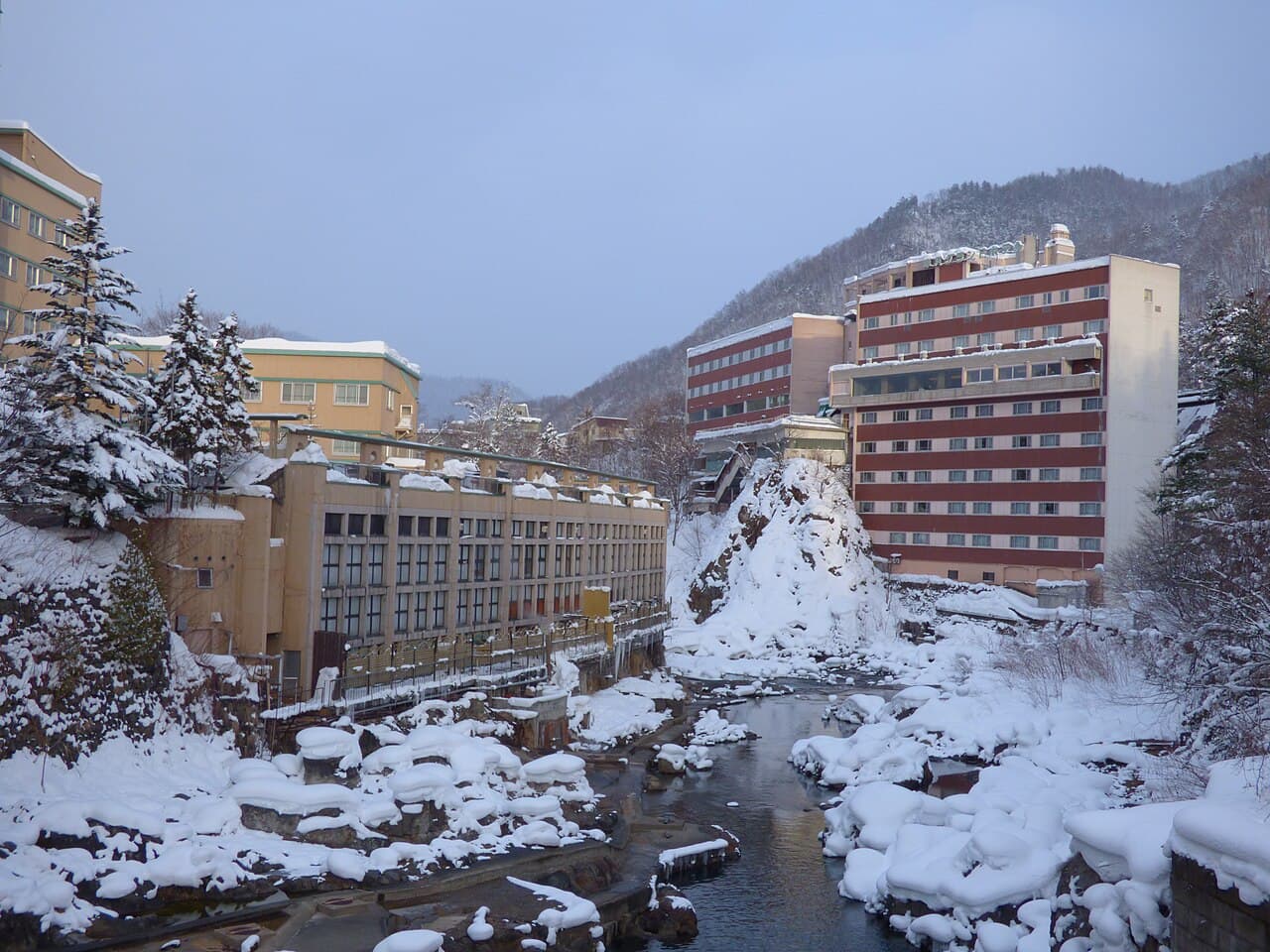
Jozankei’s central hot-spring town follows the Toyohira River in Sapporo’s Minami district. The river gorge, wooded slopes and closely grouped hotels create a different atmosphere from an isolated ryokan. Its characteristic water is clear sodium-chloride spring water: a bath does not need a milky colour or a strong sulphur smell to be an onsen.
The tourist association describes groundwater from the surrounding mountain catchment feeding springs that emerge through fractures near the river. Its regional guide also distinguishes nearby Hoheikyo’s sodium-calcium bicarbonate-chloride water and Koganeyu’s simple sulphur springs. These are neighbouring places, not identical water under different hotel names.
Official Jozankei spring and destination information ↗
Day bathing · no accommodation
Hoheikyo Onsen · 豊平峡温泉
A useful example of a bath-led visit without a hotel stay. Its large outdoor baths include Muine no Yu and Fukuro no Yu, with men’s and women’s allocation changing by day. The operator describes water flowing directly from the source, with no added water or reheating, and mineral deposits around the baths. There is no private family bath: this is a communal outdoor-bathing experience, not a bookable private pool.
Official bath information & photographs ↗
Good fit
A Sapporo-centred visit where a valley bath is the main change of scene. Choose the actual outdoor bath if snow and forest views matter more than the room itself.
Worth checking
Hoheikyo is a separate facility outside the central hotel cluster. Do not assume you can walk between every place labelled “Jozankei”, especially in winter.
02 / Southwestern Hokkaido
Noboribetsu: volcanic scenery and contrasting spring waters
In Noboribetsu, the geothermal landscape is part of the visit rather than an invisible process beneath the hotel. Jigokudani’s steaming ground helps explain why the town developed around bathing. The region is known for several spring-water types, including sulphur, chloride and iron-bearing waters—not one universal “Noboribetsu water”.
Sulphur springs are the familiar image: often cloudy white, with a distinctive sulphurous smell. Other baths can be clear or differently coloured. The worthwhile comparison is between named sources and baths within a property, not between photographs edited to look equally blue-white. A larger bathhouse may offer more water variety than a more expensive room.
Official Noboribetsu spring and destination information ↗
Classic onsen hotel · day visits also offered
Dai-ichi Takimotokan · 第一滝本館
The Grand Bath is the reason to shortlist this hotel: the current official guide lists five water types and 35 baths across the men’s and women’s areas combined. The small Kinzo no Yu reproduces a bath associated with the inn’s founder. It suits readers who want to compare waters, pool shapes and temperatures, without making a private room bath the entire purpose of the stay. Men’s and women’s areas are fixed; one guest cannot assume access to all 35 baths.
Official bath information & photographs ↗
Public bathhouse · day bathing
Sagiriyu · 夢元さぎり湯
A simpler alternative to a full resort stay. Its official bath guide identifies the sulphur-water Ichigo Otsusen bath and Menoyu, supplied from a mixed source. The attraction is a direct bathhouse experience. It should not be presented as the same product as a ryokan with dinner, an overnight room and a private outdoor bath.
In a notice dated 16 March 2023, the operator said reduced spring flow required a temporary change to iron-bearing water in the Menoyu bath. Check its latest notices for the water currently supplied before visiting.
Official bath information & photographs ↗ · Menoyu supply notice (16 March 2023)
Good fit
A bathing-focused stop in southwestern Hokkaido. Give the bathhouse time of its own; the experience is not completed by a quick photograph at Hell Valley.
Worth checking
Not every hotel has every spring type. Outdoor paths and natural features around Jigokudani are not unrestricted bathing sites, and winter access can change.
03 / Eastern Hokkaido
Lake Akan: lake-level baths, rooftop views and private retreats
Lake Akan Onsen occupies the lake’s southern shore in eastern Hokkaido. Geothermal activity is visible in the nearby bokke mud pools; the hotel baths are managed facilities, not places to enter the lake. The wider setting includes forest, volcanic mountains and Akan Ainu Kotan. Its appeal differs from Noboribetsu: the relationship between the bath and the lake often matters as much as the water itself.
Hokkaido’s official regional guide lists simple and bicarbonate springs here. “Simple” is a spring classification, not a judgement that the water is ordinary tap water or inferior. Do not assign one water profile to every property. At lake level, a bath can frame the shore closely; a rooftop bath gives a broad panorama; a room bath offers privacy but may not face the lake.
Official Lake Akan spring and destination information ↗
Photo: ブルーノ・プラス · CC BY 4.0 · Display crop
Classic resort · two very different bathing perspectives
Akan Yuku no Sato Tsuruga · あかん遊久の里 鶴雅
Hougaden, the lower-level bath complex, includes a garden open-air bath beside the lake: the shoreline is part of the immediate scene. Compare this with the upper-floor Ama no Hara complex and rooftop Tennyo no Yu, where the appeal is the wider view. This is a concrete reason to choose a substantial shared-bath resort rather than judge the stay only by its guestroom. The property identifies its water as a simple spring and discloses different water-handling arrangements for different baths.
Official bath information & photographs ↗ · Upper-floor baths ↗
Rooftop spa · a different bathing format
New Akan Hotel · ニュー阿寒ホテル
The Tenku Garden Spa presents an infinity-style view over Lake Akan. Unlike a conventional nude shared onsen, this rooftop area requires the designated bathing garment or a swimsuit. Separate large bathing areas are also available. The format is useful to understand before choosing: a shared scenic spa and a private room bath solve different needs. Outdoor operation remains weather-dependent.
Official bath information & photographs ↗
Premium ryokan · private open-air bath in every suite
Akan Tsuruga Bessou Hinanoza · あかん鶴雅別荘 鄙の座
Hinanoza is the private-retreat alternative: all suites have an open-air hot-spring bath, but room outlooks differ. Its current policy accepts guests of junior-high-school age and above, so it is not an interchangeable choice for families with young children. The private bath is a real room feature, but it should not be confused with a promise that every bath is unfiltered free-flowing spring water; the property describes circulation and filtration for its room baths.
Official bath information & photographs ↗
Good fit
An eastern Hokkaido stay with time for the lake and Ainu cultural experiences, rather than a rushed detour from Sapporo.
Worth checking
Snow, ice, wind and visibility change the view and outdoor access. A lakefront address does not guarantee a lake-facing room, and a frozen lake is not automatically safe to enter.
04 / Hakodate · southern Hokkaido
Yunokawa: chloride springs and Hakodate’s sea horizon
Yunokawa is a hot-spring district within Hakodate, not a remote mountain retreat. The town’s characteristic sodium-calcium chloride water gives it a different starting point from the sulphur-bath image associated with Noboribetsu. A coastal bath can open towards the Tsugaru Strait, while other properties sit farther inland.
The key distinction is between the spring’s chemistry and the hotel’s position. A chloride spring is not simply a seawater pool, and an “ocean-view hotel” does not mean every bath or room faces the sea. For this area, the exact bath outlook is one of the most useful details to check.
Official Yunokawa spring and destination information ↗
Coastal hotel · shared baths and day visits
Yunohama Hotel · 湯の浜ホテル
Its Taiyo and Ginga open-air baths focus on the sea horizon. Indoors, the hotel lists a large bath, cedar bath, bubble bath and reclining bath. It reports different waters for the outdoor and main bathing areas, both under the sodium-calcium chloride classification. The men’s and women’s allocation rotates. This is a specific coastal-bathing example—not a guarantee that every room includes an ocean view or private onsen.
Official bath information & photographs ↗
Good fit
A Hakodate stay combining city sights and food with time in the baths. Think through whether an included ryokan dinner or an evening eating in town is more important.
Worth checking
Some bath areas rotate between men and women. Confirm which view is available during your visit rather than relying on one promotional photograph.
04 / Ways to bathe
Day baths, classic hotels and private-bath retreats
Three ways of visiting help organise the choice: a bath without accommodation, a classic overnight stay centred on shared facilities, or a premium retreat with a private onsen. These are experience types, not a quality league table. One hotel may offer more than one of them.
Visit without staying
A day bath
A public bathhouse or a hotel admitting non-resident bathers. Hoheikyo and Sagiriyu show how the water can be the main event without an overnight room.
Confirm before booking
Non-resident admission and closure notices
Towels, lockers and what the entry fee covers
Shared or private access—not assumed
Bathing-first overnight
A classic onsen hotel
Choose a room, meals and access to substantial shared baths. Dai-ichi Takimotokan is a useful example when water variety matters more than having a private bath in your room.
Confirm before booking
Exact room category and beds or futons
Dinner plan and arrival cut-off
Which bathing areas are included
Privacy-led overnight
A private-bath retreat
Choose a premium ryokan or a specific room with its own onsen. Hinanoza and Zaborin illustrate this approach. The extra cost also reflects space, food and service—not necessarily superior spring water.
Confirm before booking
An actual hot-spring bath, not an ordinary tub
Indoor or open-air; privacy and outlook
Age restrictions and room occupancy
Zaborin: a private-bath example beyond the four core areas
Zaborin, in the Niseko area, has 15 villa suites, each with its own indoor and open-air baths. The property says both are supplied by free-flowing water from its own spring source. This is a different proposition from touring a large communal bathhouse: the room, forest setting and freedom to bathe privately are central to the stay.
It illustrates why a small private-bath retreat can feel scarce without proving that its water is “better” than a day bath. The choice is between different experiences, not simply higher and lower prices.
Zaborin — private baths and spring source.
Three terms that are easy to confuse
Rotenburo: an open-air bath; it may be communal or private.
Kashikiri: a bath reserved for exclusive use during a time slot; it is not necessarily attached to the room.
A room with a bath: confirm whether the particular bath uses hot-spring water. A beautiful ordinary tub is not the same feature as an in-room onsen.
Read the room and meal plan separately
A room with futons is not the same sleeping arrangement as a room with beds. A private outdoor bath may have steps, a partially exposed outlook or a layout unsuitable for your party. Dinner may be a buffet, a set-course meal or a separate paid option. The room category and meal plan need to describe the stay you actually want—not just repeat the word “ryokan”.
Bath terminology: Japan National Tourism Organization.
05 / How to bathe
How to bathe: a first-timer’s guide
A few simple habits make a first visit less unfamiliar. Treat this as an introduction; the signs and staff at the facility take precedence.
Check the rules before you go
Confirm the facility’s tattoo policy, children’s arrangements and private-bath requirements. Leave phones and cameras outside the bathing area.
Use the changing area
Follow the signs for the correct bath and changing room. Most traditional shared onsen are enjoyed without swimwear; follow the actual facility’s instructions.
Wash before entering
Use the washing stations and rinse away soap and shampoo before entering the bath. The bathing pool is not the place to wash.
Keep the bath peaceful
Keep towels and hair out of the water. Avoid swimming or splashing, speak quietly and respect other guests’ space.
Leave with consideration
Dry off before returning to the changing area and leave shared spaces tidy. Follow any posted instructions for the facility.
The format matters
Do not apply one swimwear rule to every facility. A traditional communal bath and a garment-required rooftop spa, such as New Akan Hotel’s, are different settings. Check the named bathing area—not just the hotel’s general description.
Tattoo policies, children’s access, mobility arrangements and private-bath rules vary. A private bath does not automatically waive a property’s admission policy. For personal health questions, seek medical advice rather than treating descriptions of spring water as medical recommendations.
Etiquette reference: JNTO’s guide to enjoying onsen.
06 / Winter planning
How to make time for a winter onsen visit
A day visit and an overnight stay need different timing
For a day bath, check the non-resident admission window and allow time to change, wash and bathe without rushing back to a transfer. For an overnight stay, a late arrival can remove both bathing time and an included dinner. Our editorial suggestion is one unhurried night for an introduction, or two when the property itself is a highlight; these are suggestions, not minimum-stay rules.
Snow views are an experience, not an inclusion
A winter photograph does not guarantee snowfall on your dates, a frozen lake, or access to the same outdoor bath. Wind and weather can change operations. Keep an indoor alternative and follow facility notices; a natural hot pool or frozen shoreline outside a hotel is not automatically open for use.
With skiing or an eastern journey
If skiing comes first, choose the resort base before adding a separate onsen town. A hotel bath near the slopes and a dedicated ryokan stay are both valid, but serve different purposes. For Lake Akan and an onward drift-ice experience, check the actual departure point and transfer plan; sharing the label “eastern Hokkaido” does not make two experiences adjacent.
Photo: Lasthib · CC BY-SA 3.0 · Display crop
The details worth checking before you go
Your travelling party
Dates, number of guests, children’s ages and any mobility needs.
The exact room and bath
Beds or futons, occupancy, privacy, water source, steps and any essential view.
Meals and arrival
What is included, dinner times, children’s meals and whether dietary requests can be accommodated.
Booking conditions
Availability, cancellation terms, additional charges and when the reservation becomes confirmed.
There is no single booking-release date, day-bath timetable or cancellation policy for the whole region. Use the facility links above for current information, and distinguish the room you have confirmed from a photograph that first caught your eye.
07 / FAQs
Questions travellers often ask
Which town should I consider for a first Hokkaido trip?
Begin with the route. For a Sapporo-centred trip, consider Jozankei; for a southwestern stay focused on bathing, compare Noboribetsu. Lake Akan and Yunokawa make more sense when eastern Hokkaido or Hakodate is already part of your journey.
Does “open-air bath” mean a private bath?
No. Open-air describes the setting; private describes who can use the space. An outdoor bath may be shared, reservable for private use, or attached to a room. Ask which arrangement is included.
Can our family bathe together?
A reservable private bath or an appropriate in-room bath may be an option. Check capacity, children’s access and the exact facility rules before booking; do not assume all family groups can use every bath together.
Can I visit if I have a tattoo?
Policies differ by facility. Check directly with the property before visiting, including whether the rule differs between communal and private baths. A cover sticker or a private bath should not be assumed to guarantee acceptance.
Is a more expensive hotel likely to have better spring water?
Not necessarily. Price also reflects room size, privacy, dining, service and the number of rooms available. A public bathhouse may have distinctive spring water; a large hotel may offer more types of water than a small luxury ryokan. Read the source and bathing information separately from the room description.
Can I use an onsen without staying overnight?
Yes, at facilities that accept day visitors. Hoheikyo and Sagiriyu are examples. Some hotels also sell day admission, but an overnight guest’s access rules may be different. Check admission times, temporary closures and towel arrangements with the actual facility.
Is Lake Akan the same onsen area as Kawayu?
No. They are separate hot-spring areas within eastern Hokkaido. Lake Akan’s appeal includes lakeside hotel baths, while Kawayu is particularly known for acidic waters associated with Mount Io. A trip through Akan-Mashu National Park does not make their waters or locations interchangeable.
How far ahead should we choose a private-bath room?
There is no single release date or booking deadline for every hotel. A small property and a particular room category can limit the available choices, especially when dates are fixed. Check the exact room, guest-age rules, meal plan and cancellation terms before treating it as part of the itinerary.
Editorial notes & sources
Source review: 3 September 2026. This guide uses official tourism and facility information, linked beside the relevant descriptions. Comparisons and suggested stay lengths are editorial judgement, not hotel rankings or claims of personal inspection.
The four detailed profiles and supplementary areas are a selected guide, not an inventory of every spring in Hokkaido. Facilities, admission rules, water arrangements and seasonal access may change; consult the actual operator before visiting. No future opening schedule, room availability or price is guaranteed here.
Photo credits are attached to each image; the hero uses the Jozankei photograph credited above. Destination photographs are not photographs of the named hotel baths. For bath images, follow the official facility links. Resized/cropped photo adaptations retain their source licences.